Visit Brilliant.org and get a 20% discount:
Previous video:
Current Clamp video:
Power form video:
Facebook:
Twitter:
Support me for more videos:
You can get a decent (4 channel, low cost) scope here (affiliate links):
You can get a differential probe here (affiliate links):
Websites which were shown in the video:
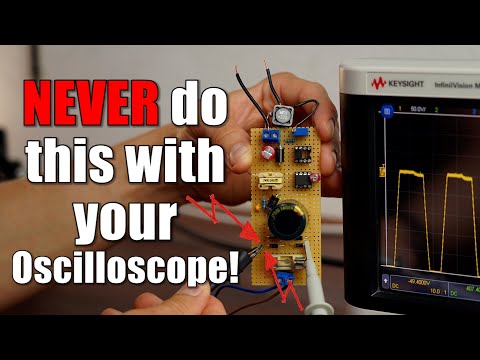
In this electronics basics episode we will be having a look at the biggest mistake you can do when working with an oscilloscope. But I will not only show you how to do safe mains voltage measurements but also show you all the basics when it comes to oscilloscopes. That means I will show you how to choose one, how to do simple voltage and current measurements and finally how FFT works. I will explain passive probes, triggering, voltage & time division, measuring functions, the cursor function, AC & DC coupling and single mode capturing. Let’s get started!
Thanks to Brilliant.org for sponsoring this video.
Music:
2011 Lookalike by Bartlebeats
0:00 The big mistake when using an oscilloscope
1:08 Intro
2:02 How to choose a scope?
4:44 Passive probes & scaling factor
5:55 Trigger
6:41 Voltage division
7:11 Time division
7:37 Measure function
7:47 Cursor function
8:19 AC & DC coupling
9:08 Single mode capturing
9:36 Current measurement
10:16 Safe mains voltage measurement
11:37 Differential probe
11:52 Math & FFT
Here are some things I would like to add to the video:
1. I do not want to shame low cost scopes in this video. I started with a 2 channel one from Rigol and it worked perfectly fine. Over the years though I noticed that 4 channel scopes are the way to go. And I also only got such expensive Keysight scopes since they gave them to me for free in order to support my work. So in a nutshell, you can start with a low cost scope just fine!
2. I heard that people would just insulate the PE connector when powering the scope in order to measure mains AC voltage. This is a TERRIBLE idea. This way you connect a possibly very high voltage to the BNC connectors. If you touch that, you have a problem because you can be partly or completely connected to PE. Only use a differential probe for that or use two scope channels and use the math function in order to calculate the difference between them.
Thanks for reading 😉
You mean I have been doing it all wrong for the last 60+ years?
As a non-electronics person these thing seem very complicated to use, so it’s really hard to imagine how people designed and actually built them. Pretty amazing.
idk why, but it annoys me how you draw everything twice
Tektronix produced the first “precision” oscilloscope in 1947, it was a device that allowed engineers to visualize and measure with great accuracy the invisible waveforms present in every electronic circuit! Every advancement over the last 75-years in electronics was preceded by an advancement in oscilloscope technology and quality. Only “visual comparative analysis” provided the engineer in understanding what is actually happening in all types of circuits, precisely measuring amplitude, frequency, and wave-shapes in oscillators, amplifiers, radios, radar, computers etc., in both analog and digital electronics. David Riddle